Recently I moved house and, during the unpacking process, unearthed a pile of treasures from my military days.
Well… “treasures” might not be the word my wife would use.
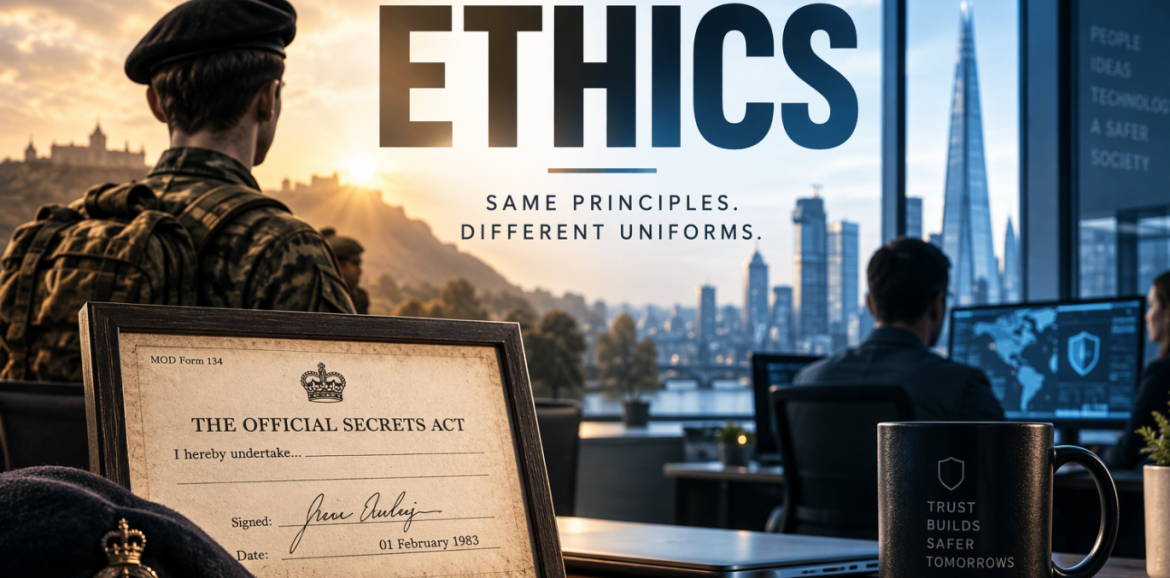
Amongst the mountain of old paperwork was a faded MOD Form 134 signed by me on 1 February 1983.
It was the first time I signed the Official Secrets Act.
Oddly enough, this scrap of paper earned a genuine “Wow, that’s pretty cool!” from my daughter, who until that moment had been firmly aligned with my wife’s view that I was simply unpacking decades’ worth of junk.
As a result, the document survived the clear-out and now proudly sits in a frame.
I was just 16 years old when I signed it.
For the next 25 years I served under the legal obligations, professional standards and personal responsibilities that came with that signature. To this day, I still don’t discuss many of the things I saw, heard or did. Even my closest family know very little about certain aspects of my career.
That piece of paper had power.
Not because somebody was constantly watching me.
Not because I feared punishment.
Because I understood the responsibility that came with it.
Ethics don’t stop at the office door
Fast forward to my current career in cybersecurity and that same mindset has stayed with me.
Like many security professionals, I belong to several professional bodies whose memberships come with Codes of Ethics and Professional Conduct. These aren’t just administrative formalities or membership conditions. They define what is expected of us as trusted professionals.
One such organisation is ISC2.
In fact, the ISC2 Code of Ethics is considered so important that CISSP candidates can expect to be tested on it during the examination process.
The Code is built around four simple but powerful principles:
- Protect society, the common good, public trust and critical infrastructure.
- Act honorably, honestly, responsibly and legally.
- Provide diligent and competent service.
- Advance and protect the profession.
(Although I still think there should be a Code of Conduct covering American spelling.)
The course that made me stop and think
While updating my CPE credits recently, I noticed that ISC2 offers a free member Express Course on the Code of Professional Conduct in Practice.
I assumed it would be a useful refresher.
A couple of hours later I realised it was much more than that.
The course explores not only the Code itself but also how to apply ethical decision-making frameworks to real-world situations through the Ethical Decision-Making Guide.
What struck me was how relevant this is beyond cybersecurity certification requirements.
It provides a practical framework for asking:
“Can I do this?”
but more importantly:
“Should I do this?”
For many of us in security, those questions are already embedded in our thinking. Ethical responsibility, confidentiality and trust are drilled into us from the start of our careers.
But should that be limited to cybersecurity professionals?
Just because you can doesn’t mean you should
This morning there was a BBC report about NHS staff accessing confidential records of high-profile patients out of curiosity rather than necessity.
Sadly, this is not unique.
Whether it’s healthcare, policing, government, finance or private industry, examples continually emerge where individuals access information simply because they can.
Curiosity is human nature.
Sometimes it drives innovation, learning and discovery.
But when curiosity crosses legal, ethical or professional boundaries, it becomes something very different.
The technology didn’t fail.
The controls didn’t necessarily fail.
The ethics failed.
The AI challenge
Now add AI into the equation.
Questions of ethics become even more important.
How are models trained?
What data is used?
How are decisions made?
What responsibilities do users have when interacting with AI systems?
Ethics is no longer solely a cybersecurity issue, nor solely a leadership issue. It’s becoming an organisational issue.
In fact, I’d argue it’s becoming everyone’s issue.
A question for leaders
The Official Secrets Act was very clear. You signed it. You understood the consequences. You knew where the line was.
Today, most employees won’t ever sign anything quite so dramatic. But that raises an important question:
What ethical standards are your people signing up to?
More importantly:
How often are those standards discussed, reinforced and demonstrated?
Because policies don’t create ethical cultures. People do.
Training helps. Leadership helps. Accountability helps. But ultimately ethics has to become part of organisational DNA.
Not just for cybersecurity teams. Not just for people handling sensitive data. For everyone.
Final thought
If you’re an ISC2 member, I’d strongly recommend spending a couple of hours on the Code of Professional Conduct Express Course and reviewing the supporting resources.
ISC2 Code of Conduct Express Course
But regardless of which professional body, vendor or industry you belong to, take some time to explore the ethical frameworks available to you.
The technology landscape is changing rapidly. The need for ethical responsibility isn’t.
And for anyone currently studying for the CISSP:
Remember, the Code of Ethics isn’t just there to help you pass the exam.
It’s for life.
A bit like getting a puppy for Christmas.